Friday, October 24, 2008

Genesis 35, or, "Everybody Dies"

Okay, not "everybody," but quite a few.

Namely, Rachel, Isaac, and a bunch of innocent townsfolk.

With Jacob's sons having just slaughtered every man in a nearby ruling tribe, God decides that it's time for him and his family to get the heck out of Dodge. God tells Jacob to flee to Bethel, the site where the stairway to Heaven was revealed to him (See Genesis 28). Jacob packs his family up and they hightail it out of there.

Just to make sure nobody follows them, God then kills everybody in the nearby towns.

Okay, to be fair, this is my interpretation of this passage. The actual verse reads: "the terror of God fell upon the towns all around them so that no one pursued them." I suppose you could take this as meaning that God spared their lives, yet paralyzed them with fear. Kind of like Gotham City at the end of Batman Begins. If God were Scarecrow, the villain.

Anyway.

Jacob and his family vamoose. On their way to Bethel, Rachel dies while giving birth to one last son, Benjamin. And then, when the family reaches Bethel, Isaac dies as well.

---

FYI: Rachel's tomb is still in existence and is the third holiest site in Judaism. You can visit a website about it HERE. There, you can learn more about the tomb, buy a pizza for an Israeli soldier, or, if your name happens to be Rachel, sign up for their project to collect the names of every Rachel in the world. Mazel tov!

Thursday, October 23, 2008

Genesis 34, or, "The Bible Suddenly Turns Into a Frank Miller Comic"

Jacob's sons go vigilante

One day, Jacob's daughter Dinah walked off into the area around their home to mingle with the other women of the land. While out, she caught the eye of the local ruler Shechem, who took her and "violated" her. He took a shine to her (he's a big romantic, evidently), and not quite understanding that this isn't the proper way to court a woman, he and his father Hamor go to see Jacob about a possible marriage between the couple.

By the time Shechem and Hamor arrive, Jacob and his sons have already learned of what happened to Dinah. Shechem is willing to offer them anything in exchange for a marriage with Dinah. Jacob's sons tell him that if he and all the males of his family get circumcised (again, a sign of one's pact with the God of Abraham), then they will give their sister over to him. Shechem accepts their terms and wasting no time he goes off and circumcises himself and the men of his family.

I imagine that recovery from a modern circumcision must be painful, so I can't even begin to think of what it must have been like back in the Biblical days (no anesthetic!). While the guys are all nursing their manhoods back to health, Jacob's sons seize the opportunity to invade Shechem's home, kill all the men in his family and ransack all their stuff.

There ain't no turning the other cheek about it. This is blood-thirsty revenge.

Pop Cultural References to Genesis 34: The Red Tent, by Anita Diamont. A book based (loosely) on the story of Dinah.

Monday, October 20, 2008

GENESIS 33, or, "Brotherly Love"

JACOB: "Dude, my bad."
ESAU: "No dude, seriously, totally my bad."


After worrying and worrying about how his brother will accept him, Jacob finally meets with Esau. To Jacob's surprise, Esau greets him with a warm embrace, and the two brothers are moved to tears by their reconciliation. All past transgressions between them are forgotten.

That's about the long and the short of this chapter. I've mentioned before how warring brothers is emerging as a theme in Genesis, and here with Jacob and Esau we have the first time that a pair of siblings have resolved their rivalry amiably. We'll have to see what happens with Jacob's son Joseph to discover if this is Genesis' last word on fraternal relations.

BONUS:
Celebrate Jacob and Esau's reunion with this nifty online coloring book!

Wednesday, October 1, 2008

GENESIS 32, or, "Wrestlemania"

Jacob heads back home, brawls with the All-Mighty

You may remember from Genesis 27 that Jacob had to flee his home because his brother, Esau, was threatening to kill him. Well, now that Jacob is going home again he thinks things might still be a little awkward between him and his sibling. Jacob sends people ahead of him to shower Esau with gifts to butter him up and hopefully hedge that murderous rage that's been building up for the last several decades.

When Jacob is left alone a man comes and wrestles with him. They fight until the dawn, when Jacob finally pins the man down and demands a blessing. The man turns out to be an angel of God (or perhaps even God himself), so the man/angel/God blesses Jacob and gives him a new name.

As I have written before, there are several interpretations to this passage, but the one I like most is that the chapter is urging us to question and "wrestle" with the ideas of the Bible. It's a story about the importance of struggling toward meaning.

Are You Ready to Rumble?:
Come to fisticuffs with God like Jacob did in this nifty flash game! Watch your hip!

Tuesday, August 19, 2008

GENESIS 31, or, "Fun with Flickr!"

I gave myself three rules for this post:

1) Take the seventh word from each verse of Genesis 31
2) Use Flickr Commons to search for the top picture relating to that word
3) If Fickr Commons doesn't come up with anything, use Google Image search

Here is the result:


Genesis 31 Recap: Jacob flees his uncle's home with Rachel and Leah, Laban chases after them, but with a little deception, Rachel gets him to leave them alone.

Wednesday, July 16, 2008

GENESIS 30, or, "Babies!"

Jacob gets it on, then gets a lot of sheep

Juicier than an issue of US Weekly, Genesis 30 gives us all the intimate details of Jacob's love life. As you may recall in the previous installment, Jacob's first wife Leah has already given him four sons.

Well, this angers Rachel, Jacob's barren second wife, so she makes Jacob sleep with her maidservant. Because for some reason Jacob having children with her maidservant is somehow like him having children through Rachel herself. I don't know, Old Testament logic is hard to follow sometimes.

Jacob has two sons with Rachel's maidservant. Not to be out done by her sister, Leah makes Jacob sleep with her maidservant, giving Jacob two more sons. Then Leah pops out two more sons and a daughter, and finally God allows Rachel to give birth to her own son, Joseph.

The second half of Genesis 30 concerns itself with how Jacob acquires his flock. Jacob asks his deadbeat uncle Laban for some payment for all the work he's been doing for the last several years. Jacob makes him agree to what appears to be a modest compensation: Every goat or sheep of Laban's that has a spotted coat will go to Jacob. Since not many of Laban's flock have this kind of coat, he agrees.

Shortly after, Jacob pulls some kind of magical scheme where he is able to speckle Laban's unspeckled flock by putting branches from poplar trees into their drinking water. Don't ask me, I've tried to do some research to figure out how this works but have come up with nothing. Anyway, the point is, Jacob scams Laban out of more goats and sheep than he had bargained for. The upshot is that Jacob becomes a rich man.

---

FYI: "Jacob sheep" is a kind of sheep that still exists today, and is distinguished by its spotted coat.

Sunday, July 6, 2008

GENESIS 29, or, "I Would Do Anything For Love"

Jacob travels to Haran, meets his uncle Laban, and finds that he gets his sheistiness from his mother's side of the family.

Jacob is shaping up to be the most interesting hero of the Old Testament so far. Unlike the previous stewards of God's blessing who were more or less virtuous through and through, Jacob starts off as a scoundrel and gradually becomes a decent person.

When Jacob arrives in Haran, he sees a beautiful woman named Rachel, whom he is told is the daughter of his uncle Laban (brother of Rebekah).

Jacob helps Rachel water her sheep (this is actually a more impressive feat than it sounds, as it required the movement of a large stone off of a well, something that would normally take several men to do). Jacob then meets Laban, who offers his nephew work and tells him that he can name his wage. Jacob is not interested in money however; he has his eyes set on Rachel. Laban tells Jacob that if he will work for him for seven years, he can take Rachel as his bride.

Because Jacob is so in love with Rachel, to him the seven years go by like days. The time comes for Laban to hand over his daughter.
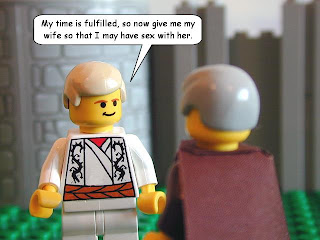
**

A feast is thrown, Jacob (I assume, though the Bible doesn't say this) gets drunk, and the next morning he rolls over to find that the person lying next to him in bed is not Rachel, but Leah, Rachel's plain-Jane older sister.
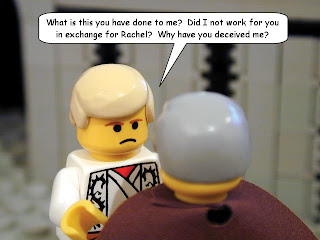


According to Laban, the custom in these here parts is to marry off the older daughter of the family before the younger daughter. And since Jacob already did the deed with Leah, they're as good as hitched. Jacob, who has swindled both his father and brother, is here swindled himself by his uncle.

Laban tells Jacob that he can still marry Rachel - if he agrees to work another seven years.

Jacob marries Rachel and starts his seven years of indentured servitude. Only, as Jacob later finds out, Rachel is barren.

Leah on the other hand, gives birth to four sons.

The Bible Two-Step: This is a new reoccurring feature I'll be posting. Sometimes the Bible will very explicitly depict its heroes partaking in behaviors or activities that in today's age are considered to be immoral. I get a real kick out of reading Bible literalists who are forced to come up with complicated arguments to justify, or "dance around", these questionable instances.

First up: polygamy.
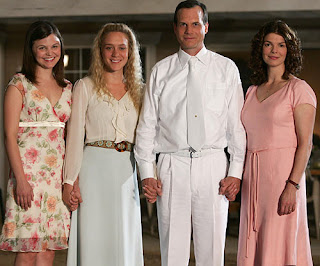


Unless you're Mormon, polygamy is seen as immoral among most people. Yet here in Genesis 29, Jacob clearly marries two wives. Let the dance begin!

From www.gotanswers.org:

"Why did God allow polygamy in the Old Testament? The Bible does not specifically say why God allowed polygamy. The best anyone can do is “informed” speculation. There are a few key factors to consider. First, there has always been more women in the world than men. Current statistics show that approximately 50.5% of the world population are women, with men being 49.5%. Assuming the same percentages in ancient times, and multiplied by millions of people, there would be tens of thousands more women than men. Second, warfare in ancient times was especially brutal, with an incredibly high rate of fatalities. This would have resulted in an even greater percentage of women to men. Third, due to the patriarchal societies, it was nearly impossible for an unmarried woman to provide for herself. Women were often uneducated and untrained. Women relied on their fathers, brothers, and husbands for provision and protection. Unmarried women were often subjected to prostitution and slavery. Fourth, the significant difference between the number of women and men would have left many, many women in an undesirable (to say the least) situation.

So, it seems that God allowed polygamy to protect and provide for the women who could not find a husband otherwise. A man would take multiple wives and serve as the provider and protector of all of them. While definitely not ideal, living in a polygamist household was far better than the alternatives: prostitution, slavery, starvation, etc. In addition to the protection / provision factor, polygamy enabled a much faster expansion of humanity, fulfilling God’s command to “be fruitful and multiply, fill the earth” (Genesis 9:7). Men are capable of impregnating multiple women in the same time period…causing humanity to grow much faster than if each man was only able to produce one child each year."


You heard it here first folks: If you want to have a second wife, just make sure you're saving her from a life of prostitution!

**Lego pictures are from www.thebricktestament.com. Please go visit the site - it's wonderful!